Supply, Demand, Price, and Maximum Empower
8 minute read
In the previous reflection, I suggested that price signals are often interpreted as drivers of economic activity when they are more accurately understood as responses to underlying changes in production and the availability of money. This raises a related question: how should we interpret the familiar supply and demand framework, where price appears as the central organizing signal of the economy? The supply and demand diagram is often treated as a foundational representation of how markets operate, with prices adjusting to balance buying and selling behavior and quantities following accordingly.
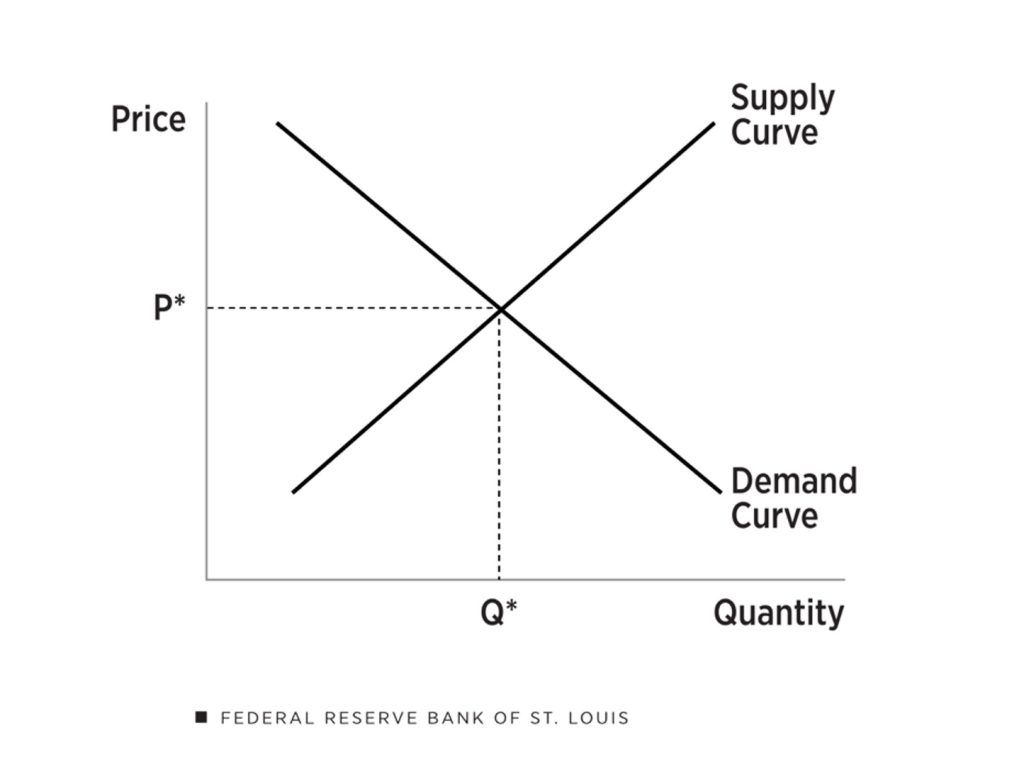
The Supply and Demand Framework
Even when considered on its own terms, the familiar supply and demand diagram abstracts away much of what governs how economic activity is organized. The curves represent willingness to buy and willingness to sell, but they are not grounded in the energy, materials, and information required to produce goods. They exist entirely in monetary space. What is being exchanged is measured in dollars, not in the work required to make the product possible or how it contributes to the performance of the system.
The separation between supply and demand introduces a second simplification. In the diagram they appear as independent forces, one representing producers and the other consumers. In reality, both arise from the same process of production. Supply depends on the organization of labor, technology, and resources, while demand depends on the incomes generated by that same process. They are not independent curves so much as two expressions of a single, coupled system.
Price itself is presented as the outcome of this interaction, appearing at the intersection of the two curves. But the diagram does not show how price is formed, how information is transmitted, or how expectations change over time. There is no representation of feedback. Price simply appears, as if the processes that generate it were instantaneous and frictionless.
Another assumption embedded in the diagram is that the economy moves between well-defined equilibrium states. The relationship between price and quantity is specified by the curves, so that if price rises, quantity is expected to fall, and if price falls, quantity is expected to rise. These responses follow from the assumed structure of the model, which defines equilibrium as the condition in which willingness to buy and willingness to sell are brought into balance, rather than as an outcome observed in a dynamic system. In this formulation, each transaction is implicitly treated as contributing to that balance.
A related assumption is that adjustments are smooth and reversible, with the system moving predictably from one state to another. Real production systems do not behave this way. Investments are made, infrastructure is built, and organizations are restructured. These changes persist. Once the system has adjusted, it cannot simply return to its previous state by reversing the price signal.
Finally, the diagram treats goods as if they exist in isolation. Each market is represented separately, with its own supply and demand curves. Yet every good is produced through a network of interconnected processes. Energy, materials, and information flow through multiple stages before appearing as a final product. A change in one part of the system propagates through many others. The single market diagram cannot represent this interconnected structure.
Taken together, these limitations do not make the supply and demand framework useless, but they do make clear that it is a simplified representation of how price and quantity co-vary within a market. It assumes that supply and demand are independent, that the economy moves between well-defined equilibrium states, and that adjustments are smooth and reversible, with price emerging instantaneously at their intersection. These assumptions make the model tractable, but they also restrict its interpretation. What appears as a general description of market behavior is, in fact, a constrained representation of a much more complex process.
Allocation and Its Objective
Economics is often described as the study of how scarce resources are allocated among competing uses. In this formulation, price serves as the mechanism through which that allocation occurs. Changes in supply and demand lead to changes in price, and those price changes are understood to direct resources toward their most efficient uses.
The question is not whether resources are allocated, but what principle governs that allocation?
Efficiency is often invoked as the objective, but efficiency relative to what measure? In practice, the economy does not allocate resources arbitrarily. Through changes in price, it reorganizes flows by altering the ability of different activities to access and maintain the energy, materials, and information they require. When the cost of inputs rises, the flows supporting some activities can no longer be maintained at existing levels. As prices adjust, these activities lose access to required inputs, their throughput declines, and the pathways they represent weaken or disappear. The resources that once supported them become available to other pathways, allowing alternative uses to expand. In this way, price does not simply signal scarcity. It acts as a feedback mechanism that redistributes flows across the system.
The result is a continual reorganization of the system, not toward equilibrium, but toward configurations that more effectively capture and use available energy, materials, and information.
From a systems perspective, this process can be understood as a form of selection. As flows are redirected, some uses decline while others expand. The question is not simply which activities can persist, but which contribute more effectively to system performance. In this sense, allocation is not governed by efficiency in the abstract, but by the tendency of the system to organize around uses that enhance overall system performance. This tendency is consistent with the Maximum Empower Principle, in which systems evolve toward configurations that maximize the use of available emergy and prevail over less effective alternatives.
Price and System Performance
This process becomes most visible when the goods in question are essential to the operation of the system, such as food or energy. In these cases, rising prices do not eliminate demand. Instead, they force a reallocation of monetary flows. A larger share of available income is directed toward maintaining these resource flows, while other activities contract. The effect is not simply a reduction in consumption, but a restructuring of the economy around the processes that contribute most to overall system performance.
A similar process occurs on the supply side. Rising prices for primary resources make it possible to apply more labor, energy, and technology to sustain production. Lower-quality deposits are brought into use, and additional effort is directed toward maintaining the flow. At the same time, pathways that do not contribute to overall system performance lose access to the flows required to persist, while resource flows are redirected toward those that enhance the system’s capacity to capture and utilize available emergy.
The Role of Speculation
Prices often respond before physical changes in supply are fully realized. Anticipation of scarcity leads to rising prices in advance of actual shortages. From a systems perspective, this behavior functions as a feedback mechanism. It accelerates the reorganization of the economy by redirecting resources toward uses capable of operating under emerging conditions.
In energy systems theory, when available energy becomes constrained, systems reorganize so that remaining flows are directed toward pathways that enhance overall system performance. Price signals help accomplish that redistribution, and speculation can amplify the signal, accelerating the adjustment before the constraint is fully expressed in physical terms.
In this sense, allocation is not simply a matter of distributing scarce resources. It is part of a broader process through which the system organizes itself to maximize the useful work it can perform, consistent with the Maximum Empower Principle.
Price and Its Biophysical Basis
This interpretation of price and allocation raises a deeper question. If price functions as a feedback mechanism that reorganizes flows toward higher system performance, why does it so often appear to misrepresent the underlying realities of resource use and environmental support? Why do monetary signals frequently diverge from the biophysical processes that sustain the economy?
The difficulty lies in the units themselves. Monetary price measures exchange value, but it does not directly represent the emergy required to produce goods and services, nor their contribution to the system’s capacity to perform work. Emergy, while derived from past energy transformations, reflects the ability of those products and processes to support and organize future work within the system. In practice, monetary flows are mediated through human economic activity, so price reflects the labor, services, and institutional arrangements required for production, rather than the total emergy required to sustain those processes. As a result, the feedback signal guiding allocation is only loosely connected to the underlying flows of energy, materials, and information that determine what the system can actually support.
One way to reconnect these perspectives is through EMPRICE, the ratio of emergy to monetary value (sej/$). By expressing monetary value in terms of the emergy required to generate it, EMPRICE provides a means of linking monetary flows to the biophysical processes that sustain them. The next reflection explores how this relationship can be used to reinterpret price, allocation, and economic performance from an emergy perspective.