Energy Shocks and Economic Reorganization
5 minute read
Recent events in the Middle East have once again focused attention on the relationship between energy and the economy. The war with Iran and the closure of the Strait of Hormuz have interrupted a shipping route through which roughly one fifth of the world’s oil normally passes. The Strait is widely regarded as the most important energy chokepoint in the global economy, carrying not only crude oil but also large flows of LPG, LNG, and refined petroleum products.
Economists and energy analysts are divided about the likely consequences. Some warn that interrupting such a large share of global oil transport could trigger a severe economic shock through rapidly rising energy prices and inflation. Others argue that modern economies are far less vulnerable than they were fifty years ago. Their reasoning is straightforward. The U.S. economy today is several times larger than it was in the early 1970s, yet it consumes roughly the same quantity of oil. From this observation many conclude that the economy has become dramatically more energy efficient and therefore less sensitive to oil supply disruptions.
At first glance the evidence cited by economists appears persuasive. If economic output has increased while energy consumption has remained roughly constant, energy intensity must have declined. The implication is that technological progress and structural change have largely decoupled economic growth from energy use.
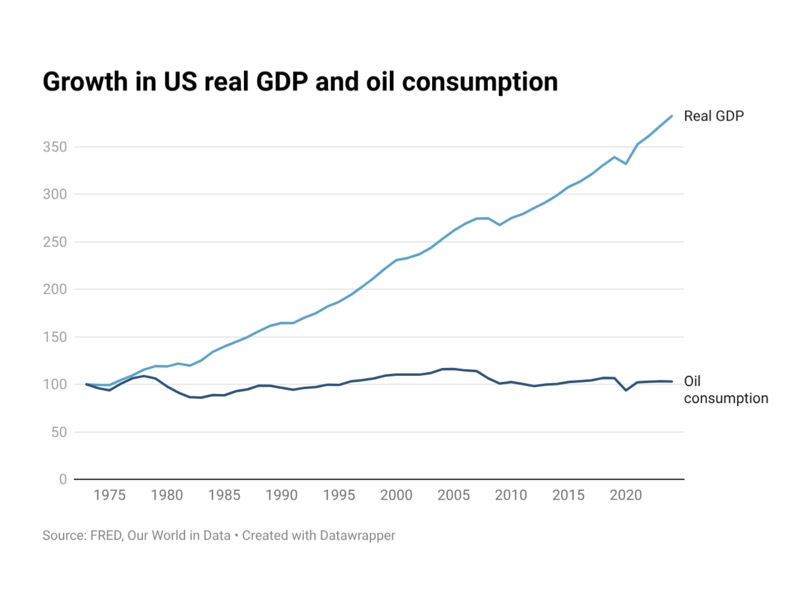
From an emergy perspective, however, this conclusion may be premature.
The apparent decline in energy intensity may not reflect only technological efficiency. It may also reflect changes in the monetary denominator used to measure economic activity. GDP measures the monetary value of transactions occurring within the human economy. It records the circulation of money and credit, not the emergy supporting production.
Emergy, by contrast, represents the accumulated environmental work previously required to produce the energy, materials, and information that sustain economic activity.
Over the same half century in which GDP expanded severalfold, the quantity of money and bank-created credit circulating through the economy expanded enormously as well. When monetary claims grow faster than the emergy and empower supporting economic activity, ratios such as GDP per unit of energy naturally increase. What appears as improved energy intensity may therefore partly reflect the expansion of monetary accounting rather than a proportional increase in the real work supporting production.
A second issue raised in current discussions concerns inflation. Economists often interpret rising oil prices primarily through the lens of purchasing power. When the price of oil rises, more money must be devoted to acquiring fuel, leaving less available for other goods and services. In this view the principal concern is the redistribution of spending within the monetary economy and the possibility that higher energy prices may trigger broader inflation.
This interpretation is not incorrect, but it is incomplete.
From an emergy perspective, the deeper issue is not simply the price of oil but the change in empower available to support production. A disruption of supply reduces the flow of concentrated energy entering the economy. Because all production requires energy, materials, and information organized through networks of transformation, a reduction in concentrated energy affects every sector of the economy.
During a disruption of supply the monetary system cannot increase the empower available to production. It can only redistribute claims on the remaining supply. Rising prices are the mechanism by which that redistribution occurs. As oil becomes scarce, the sectors capable of paying higher prices secure access to the fuel while other sectors reduce consumption or alter production.
The emergy of petroleum is the same regardless of its price. What increases is the number of monetary claims competing for access to that accumulated environmental work. Oil shocks therefore intensify the competition among monetary claims for the same emergy.
Public discussion tends to focus almost entirely on crude oil because gasoline prices are visible each time drivers fill their tanks. Yet crude oil is not the only form of energy passing through the Strait of Hormuz. Large volumes of liquefied petroleum gas, liquefied natural gas, and refined petroleum products also move through this narrow corridor.
| Energy Forms Passing Strait of Hormuz | |||
| Energy form | Flow rate | Emergy | % of Total |
| Crude oil & condensate | 14.9 Mbbl/day | 5.81E+24 | 32% |
| Refined petroleum products | 5.9 Mbbl/day | 2.86E+24 | 16% |
| LPG | 1.5 Mbbl/day | 3.89E+23 | 2% |
| LNG | 10.4 Bcf/day | 9.12E+24 | 50% |
| Total | 1.82E+25 | 100% | |
The influence of these flows depends not only on their quantity but on their position in the hierarchy of production. Some fuels function primarily as energy for transportation or heating. Others serve as feedstocks supporting the transformation of materials. LPG and LNG occupy positions high in the industrial hierarchy because they support petrochemical production that yields plastics, fertilizers, synthetic fibers, and numerous industrial chemicals. These materials in turn support many layers of manufacturing, agriculture, and distribution.
For this reason disruptions affecting LPG and LNG propagate through the structure of production rather than appearing primarily in retail fuel prices. The systemic consequences may therefore extend far beyond what is suggested by gasoline prices alone.
Total global fossil fuel use in 2025 was approximately 7.5 × 10²⁵ sej per year. The emergy passing through the Strait therefore represents roughly one quarter of the empower supporting the global economy.
The question is not simply how gasoline prices will respond to events in the Middle East. The more fundamental question is how the global biophysical economy will respond to a disruption affecting roughly one quarter of the emergy flowing through one of its major energy gateways.
Modern economic analysis tends to focus on prices, interest rates, and monetary flows as if these forces drive the economy. From a biophysical perspective the causality runs in the opposite direction. Production begins with flows of energy, materials, and information organized through hierarchical transformation. Money enters later as a mechanism for allocating claims on the results of that production.
The expansion of monetary claims can obscure these underlying relationships. When credit and money grow faster than the emergy supporting production, economic indicators may continue to rise even while the energetic foundations of the system remain unchanged.
Financial markets sometimes respond even before a physical disruption is fully realized. Anticipation of scarcity leads traders and investors to bid up prices in advance of actual shortages. In energy systems theory, when available energy becomes constrained, systems reorganize so that the remaining flows are directed toward pathways capable of sustaining the highest overall system performance. Price signals help accomplish this redistribution. Speculation often amplifies the signal and accelerates the adjustment. Higher prices begin redirecting energy toward uses capable of sustaining greater output even before the constraint has fully propagated through the economy. In this sense speculation can accelerate the reorganization of the economy around the available empower.
For this reason, following the money alone can be misleading. Prices and financial signals record adjustments within the economic system, but the underlying driver remains the availability of energy and materials that sustain production. In that sense, following the money is like looking through the rear-view mirror. It tells us how the system is responding, not the forces that determine where it can ultimately go.
When major energy flows are interrupted, the monetary economy does not determine the outcome. It adjusts to it.