Continuing — Money, Debt, and Energetic Capacity
5 minute read
In the previous reflection, we established that real wealth is not money itself, but the accumulated environmental work organized through hierarchical processes of production. Money does not constitute wealth; it represents a claim on future production.
I use the term production deliberately. Energy is necessary, but energy alone does not tell the full story. Wealth is not merely energy throughput. It reflects the accumulated work of the biosphere, including the contributions of humans operating within it. This work includes the geologic processes that concentrate fuels and minerals, the ecological cycles that renew soils, water, and biomass, and the human organization that converts these into useful structure.
Framed this way, a practical question follows: how can production be represented quantitatively?
Some approaches rely on embodied energy, assuming that the energy required to make something adequately represents its value. Yet production depends on more than energy alone. Transformation requires energy, materials, and the information needed to organize those materials into useful structure.
There is no need here to revisit an introduction to emergy. Most participants on this list are already familiar with its basis. Suffice it to say, emergy provides a means of expressing these requirements in common units, as the accumulated work previously required to produce them.
If we sum the emergy supporting the operation of the United States economy during a year, we obtain an estimate of the accumulated biospheric work required to sustain that year’s production. I refer to this quantity as Gross Emergy Product (GEmP), expressed in solar emjoules per year (sej/yr).
Economics provides a parallel accounting through Gross Domestic Product (GDP), the monetary value of goods and services produced within national boundaries. GDP captures market and institutional production, while much of the environmental work supporting production remains outside monetary accounting.
This difference matters.
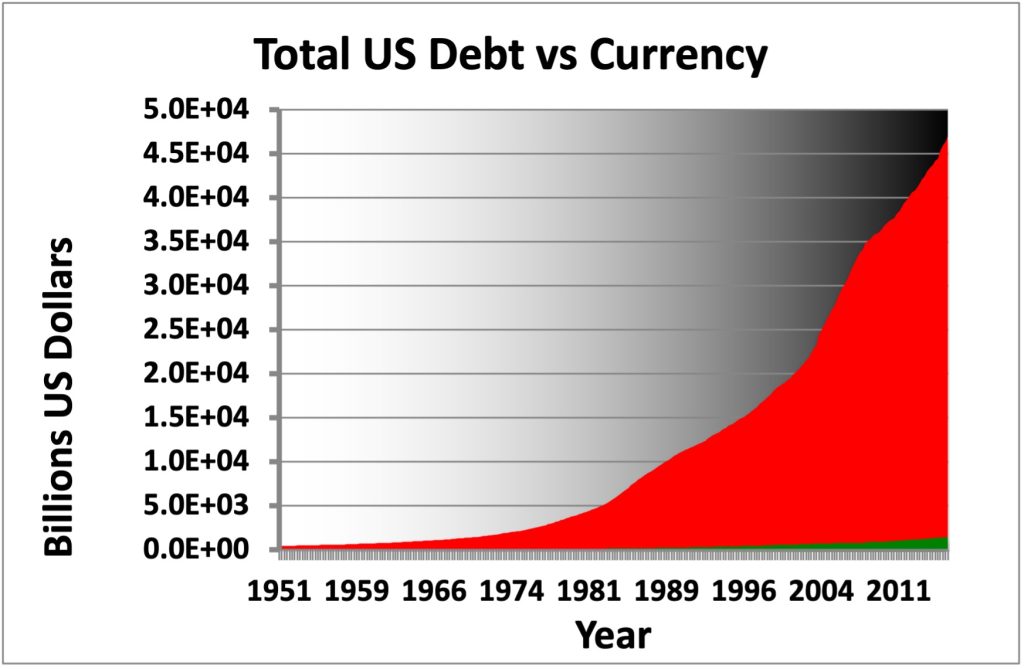
An important feature of modern economies is that most monetary transactions supporting GDP do not originate as sovereign currency (fiat money). Roughly 90% of transactional money arises as bank-created credit. Fiat money is created directly by monetary authorities, whereas credit money is created through commercial lending. Credit cards, mortgages, business loans, corporate borrowing, and lines of credit therefore play a dominant role in organizing production.
Whether those claims can ultimately be honored depends not on monetary expansion, but on the capacity of the biosphere and human economy together to sustain production.
Stocks and flows
Both money and emergy may be understood as either stocks or flows. In the present discussion, however, we are concerned with flows, specifically the annual rates at which money and emergy move through the economy in support of production. GDP and GEmP each describe these annual flows from different perspectives.
In economic transactions, monetary payments and production move in opposite directions. Dollars flow toward producers, while goods and services flow toward consumers. Price regulates this exchange. Expressed from an emergy perspective, I refer to this relationship as emprice, the emergy received per dollar exchanged.
The Gross Emergy Product of the United States economy in 2022 is shown in the accompanying table. The values represent the accumulated environmental work required to sustain annual production. One feature is immediately apparent. Nonrenewable energy accounts for less than 1/3rd of total emergy inputs supporting the economy.
Emergy supporting the US economy (2022)
| Source | Emergy (x1024 sej/yr) | Percent of Total Inputs |
|---|---|---|
| Renewable emergy 1. | 3.5 | 5% |
| Nonrenewable energy 2. | 22.0 | 31% |
| Materials (minerals & metals) 3. | 26.1 | 36% |
| Imported goods 4. | 20.0 | 28% |
| Exports 5. | -7.4 | -10% |
| Total | 64.2 |
2. Sum of domestic and imported coal, oil, NG
3. Sum of domestic and imported minerals & metals
4. Sum of imported finished products (excluding services)
5, Sum of energy and finished products (excluding services)
When the annual monetary flow expressed as GDP is compared with the emergy flow expressed as GEmP, we are not simply comparing two accounting systems. We are comparing two descriptions of the same production process viewed from opposite directions. GDP records the circulation of monetary claims generated within the human economy. GEmP expresses the accumulated environmental work required to sustain that production.
In each transaction, these flows move counter to one another. Monetary payments move toward producers, while emergy embodied in goods and services moves toward consumers. Price regulates the exchange between them. Expressed in emergy terms, emprice describes the rate at which accumulated environmental work is exchanged for monetary claims.
The table also highlights an observation relevant to current discussions of trade policy. When expressed in emergy terms, exports represent roughly one third of imports. This contrasts with the common assumption that a negative monetary balance of payments necessarily weakens the domestic economy.
Money and resources move in opposite directions. Dollars flow outward to pay for imports, while the energy, materials, and organized work embodied in those imports flow inward. If the monetary balance is negative, the associated emergy balance is positive, assuming broadly comparable emprices for imports and exports. Under those conditions, the domestic economy receives a net inflow of emergy.
Because money and resources move in opposite directions, following monetary flows alone amounts to reading the system backwards. Financial signals reveal where claims accumulate. They do not necessarily reveal where the capacity to sustain production is being created or diminished.